logo
Menu

STI Steering Commitee

Research Collaboration
Research Infrastructures
Innovation Collaboration
Sustainability
STI Steering Committee

BRICS Working Group on Biotechnology and Biomedicine

The BRICS Working Group on Biotechnology and Biomedicine was established by the decision of the 4th BRICS STI Ministerial Meeting in 2016 in Jaipur (India). The coordinators of the Working Group are Russia and Brazil.

BRICS Working Group on Ocean and Polar Science and Technology

The BRICS STI Ministers at their 3rd STI Ministerial Meeting in October 2015 in Russia adopted the Moscow Declaration encouraging new initiatives, in particular, cooperation on Ocean and Polar Science and Technology. The mission of the Working Group is to promote cooperation between BRICS member countries in the field of ocean and polar science. The coordinators of the Working Group are Russia and Brazil.

BRICS Working Group on Geospatial Technologies and its Application

The BRICS Geospatial Working Group was established in 2015 by the Moscow STI Ministerial Declaration. The coordinator of the Working Group is India.

BRICS Working Group on Prevention and Mitigation of Natural Disasters

The BRICS Working Group on Prevention and Mitigation of Natural Disasters – coordinated by Brazil – was established in line with the BRICS MoU on STI Cooperation and following the outcomes of the Moscow STI Ministerial Declaration of 2015.

BRICS Working Group on New and Renewable Energy and Energy Efficiency

Energy efficiency has been high on the agenda of the BRICS group of countries. The Working Group was established in accordance with the Declaration of the BRICS countries, signed in Durban at the 6th Meeting of the Ministers of Science, Technology and Innovation on 3 July 2018. The Working Group is coordinated by China.

BRICS Working Group on Solid State Lighting

The BRICS STI Work Plan 2015-2018 envisages the decision to develop direct communication channels between STI stakeholders including Solid State Lightning as a sub-area of Energy efficiency. The topic is being led by China.

BRICS Working Group on Astronomy

The main aim of the BRICS Astronomy Working Group (BAWG) is to exploit the basic strengths for the mutual betterment of the general population amongst the BRICS member countries. The Working Group is coordinated by South Africa.

BRICS Working Group on Material Science and Nanotechnology

The Working Group was established in accordance with the Declaration of the BRICS countries, signed in Hangzhou at the 5th Meeting of the Ministers of Science, Technology and Innovation on 18 July 2017. The Working Group is coordinated by Russia and India. The Working Group coordinates the Virtual Centre – BRICS Network Centre for Materials Science and Nanotechnology (NCMSN).

BRICS Working Group on Photonics

According to the BRICS Hangzhou Declaration signed at the 5th BRICS Science, Technology and Innovation Ministerial Meeting on July, 18 2017 it was agreed to establish the BRICS Working Group on Photonics. The Working Group is coordinated by Russia and India. The Working Group coordinates the BRICS Virtual Institute of Photonics.

BRICS Working Group on High Performance Computing Artificial Intelligence

The Working Group on ICT and HPC is aimed at achieving substantive outcomes under the BRICS STI Framework Programme in the areas of significant impact on globally challenging issues such as industrial restructuring and upgrading, intelligent manufacturing, healthcare delivery, precision farming, pollution control, the development of smart cities and other areas. The Working Group is coordinated by China. The Working Group coordinates an integrated Hub for BRICS Innovation Collaboration on ICT and HPC.

BRICS STI Funding Working Group

The BRICS Science, Technology and Innovation (STI) Funding Working Group is a crucial mechanism of cooperation among BRICS countries, aimed at promoting cooperation between government institutions, funds and other funding agencies. The main objectives of this Working Group are to organize joint multilateral calls for scientific research projects among the BRICS countries, including the creation of a joint secretariat for calls, structures, and mechanisms for conducting and coordinating joint calls. Since 2016 coordinated calls for multilateral research projects are launched under BRICS STI FP inviting researchers from BRICS member states to jointly carry out basic, applied and innovation research projects on multilateral approach.

BRICS Working Group on Research Infrastructure and Mega-Science Projects

The key objectives of the Working Group on Research Infrastructures and Mega-Science Projects include promoting cooperation within large-scale research infrastructure, supporting initiatives leading to efficient use, development and management of mega-science projects and creating a dynamic environment for the development of Research Infrastructures among the BRICS countries. It provides the opportunity for fundamental and translational research, leading to finding solutions for the BRICS's common challenges and the world at large. The Working Group is also responsible for the establishment of the digital platform – the BRICS Global Research Advanced Infrastructure Network (BRICS GRAIN).

BRICS Working Group on Science, Technology, Innovation and Entrepreneurship Partnership

The BRICS Working Group on Science, Technology, Innovation and Entrepreneurship Partnership was established in 2016 in order to foster cooperation among BRICS countries in the innovation sphere. The BRICS Working Group aims to promote collaboration in the development of science, technology, and innovation policies, as well as to create robust and sustainable innovation ecosystems within the BRICS.

iBRICS Innovation Network

The BRICS Working Group on science, technology, innovation and entrepreneurship partnership was established in 2016 in order to foster cooperation among BRICS countries in the innovation sphere. The BRICS Working Group aims to promote collaboration in the development of science, technology, and innovation policies, as well as to create robust and sustainable innovation ecosystems within the BRICS. The BRICS Working Group has adopted several key initiatives, including the creation of the iBRICS Innovation Network — a platform for direct communication between science parks, business incubators, accelerators, and other innovation organizations in BRICS countries. The iBRICS Network aims to build direct communication channels (online platforms, information days, partner search, etc.) between these organizations, conduct joint training programs on the management of science and technology parks and business incubators, assist in the creation of transnational small and medium-sized enterprises in BRICS countries, support the exchange of high-tech enterprises in BRICS markets through a soft landing strategy and ensure the participation of innovative SMEs in addressing socio-economic challenges in BRICS countries.

BRICS TechTransfer Network

Another major initiative of the Working Group is the BRICS TechTransfer Network, which provides a mechanism for dialogue and cooperation among BRICS countries to share experience and best practices in technology transfer. The network aims to stimulate technology transfer in order to improve competitiveness and increase the volume of innovative products of the BRICS countries.

BRICS Young Scientist Forum

The key tasks of the BRICS YSF are: - To provide a platform for connecting & networking amongst the BRICS youth in order to harness their knowledge for resolving common societal challenges through research and innovation. - To build BRICS leadership in S&T through the creative youth with capacity and capability to accelerate change individually and collectively (BRICS Youth Alumni). - To reinforce BRICS nation’s and regional STI policies, youth policies, skills development and entrepreneurship policies.

BRICS Water Forum

One of the key goals of the BRICS Water Forum is the establishment of a common water resources community of researchers and experts working in BRICS countries; and the identification of existing capacities to undertake joint research and development, as well as technology transfer to address the needs of the water sector and the related sectors. BRICS Water Forum unites leading scientists and researchers in the area of water resources from BRICS countries and is a good platform for presenting and discussing sustainable water use and management solutions.

BRICS Academics of Science

The aim of Academies networking is to drawn on and support the Memorandum on STI Cooperation by providing evidence-based science advice to the governmental STI bodies and executive structures within BRICS. The Meeting projects to establish, strengthen and sustain productive joint activities within BRICS with a view to augment capacity development in STI. The role of Academies within BRICS will be determined by a Strategic Plan which is now under elaboration.

Foresight and STI Policy

The key tasks of the annual BRICS Special Seminar are: - Formation of a strategic system for cooperation in the field of STI between the BRICS countries. - Search for answers to common global and regional socioeconomic challenges in the BRICS countries using shared experience and complementary opportunities in STI. - Joint acquisition of new knowledge and creation of innovative products and services using appropriate financing and investment mechanisms. - Promoting partnerships of BRICS members with other strategic partners of the developing world in the field of STI.
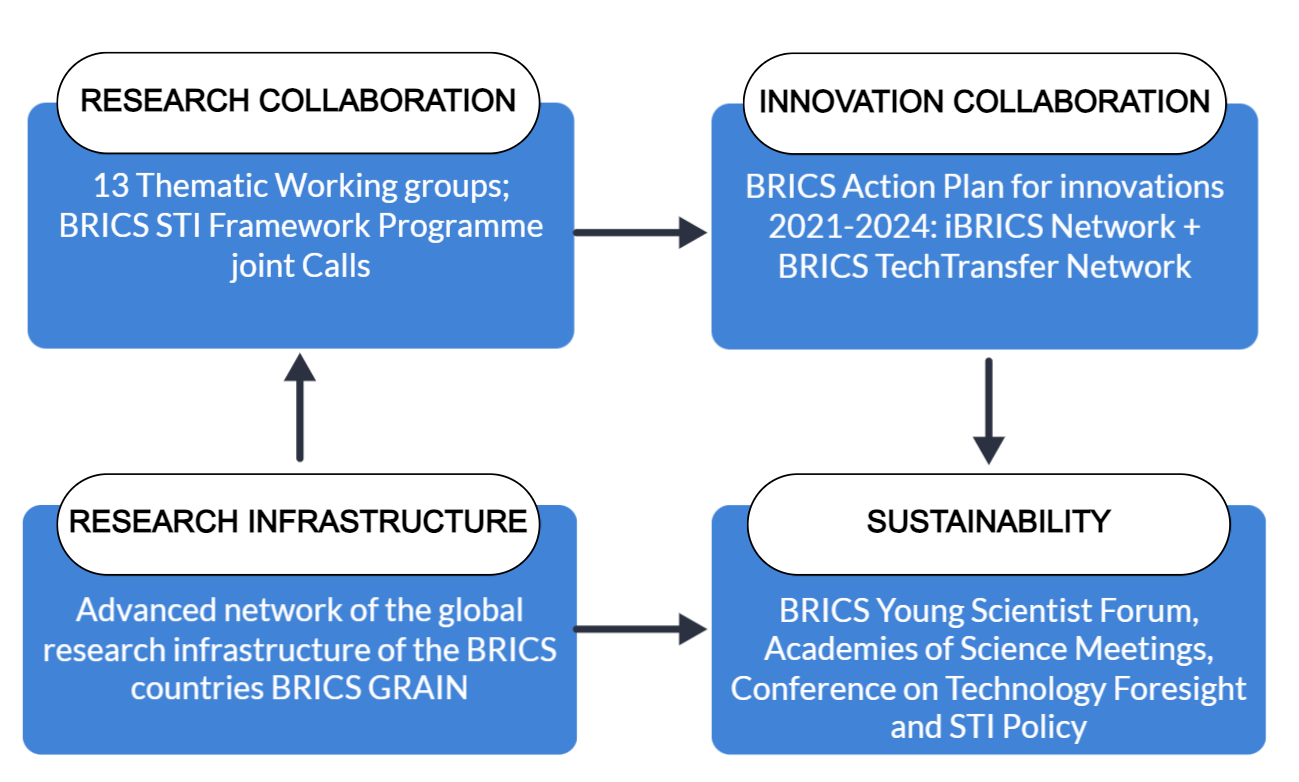
The New BRICS STI Architecture embraces the Ministerial and Senior Officials meetings, activities of 13 thematic Working Groups, joint calls for research projects, the BRICS Young Scientist Forum and the BRICS Young Innovator Prize, BRICS Science Academies Meeting and the Conference on Technology Foresight and STI Policy. The BRICS STI Architecture is built on four key areas of cooperation, including cooperation in the field of research collaboration, research infrastructure, innovation collaboration and sustainable development. The research cooperation track comprises 13 thematic STI working groups and the key mechanism for supporting coordinated research project calls – BRICS STI Framework Programme. To implement this architecture, the BRICS STI Steering Committee was established in 2020, consisting of 2 members from each BRICS country. The committee is responsible for: • monitoring the implementation of science, technology, and innovation activities of BRICS countries; • coordinating joint research project calls under the BRICS STI Framework Programme; • providing information, analytical, organizational and technical support for BRICS STI activities.