The Role of Regional Financial Arrangements in Reducing Dependence on the International Monetary Fund
In general terms, regional financial arrangements (RFAs) play a crucial role in strengthening economic stability and responding to financial crises. Comparative analysis shows that each region, based on its economic capacity, political structure, and strategic priorities, has adopted a distinct model of financial cooperation.
The Experience of the Middle East and North Africa
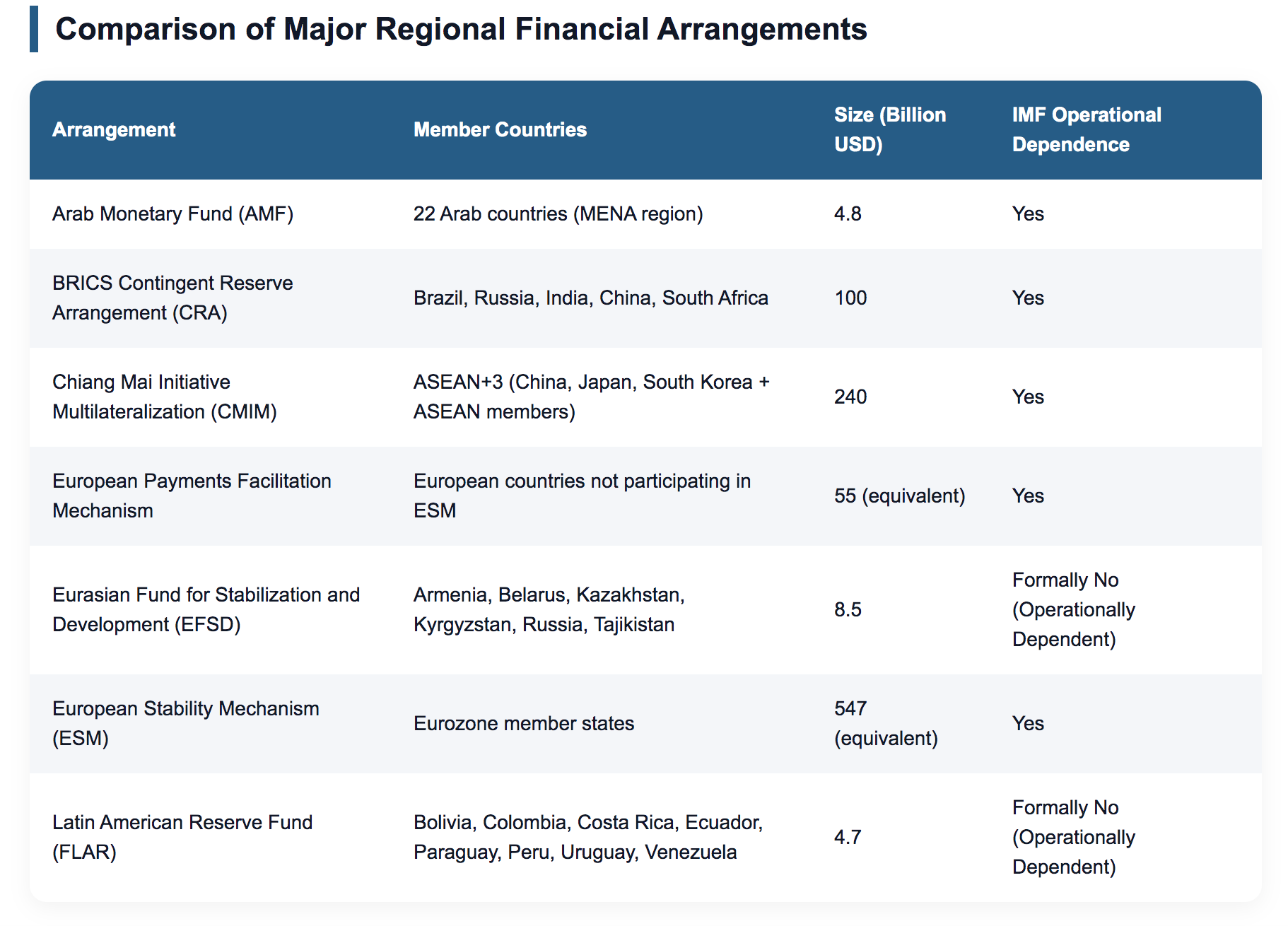
In the Middle East and North Africa (MENA) region, the Arab Monetary Fund (AMF) serves as the primary regional financial mechanism. With 22 member states and operational coordination with the International Monetary Fund (IMF), the AMF maintains a relatively limited lending capacity of approximately USD 4.8 billion.
In contrast, the BRICS countries established the Contingent Reserve Arrangement (CRA) with a financial backing of USD 100 billion, aiming to enhance financial autonomy and reduce reliance on Western-dominated financial institutions.
In East Asia, the Chiang Mai Initiative Multilateralisation (CMIM) was formed among the ten ASEAN member states together with China, Japan, and South Korea. With a financial capacity of USD 240 billion, CMIM represents one of the largest regional liquidity arrangements, although it still maintains partial linkage to IMF coordination mechanisms.
The Experience of Europe and Latin America
In Europe, regional financial structures operate in a more advanced and integrated manner. The European Stability Mechanism (ESM) and other European Union financial instruments function with substantial financial capacity and represent a model of deep regional financial integration.
Additionally, the Eurasian Fund for Stabilization and Development (EFSD) and the Latin American Reserve Fund (FLAR) were established to support member countries during currency crises, debt pressures, and external economic shocks.
Global Trends and the Shift Away from IMF Dependence
Overall, global trends indicate that countries are gradually reducing their dependence on the IMF and moving toward the development of regional financial safety nets. These networks aim to preserve economic sovereignty while providing faster and more context-specific responses to member states’ financial needs.