
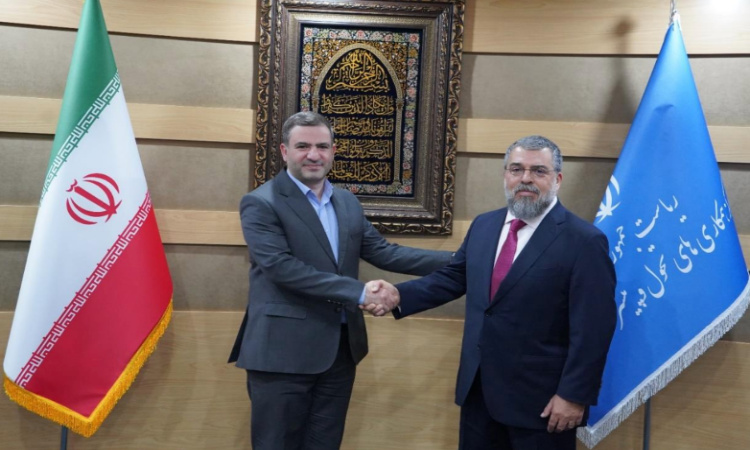
On Sunday, September 21, the Head of the Center for Transformation and Progress of the Iranian Presidency met with the Ambassador of the Federative Republic of Brazil in Tehran to discuss mechanisms for expanding bilateral cooperation in various fields of science, technology, and innovation.
During the meeting at the Center for Transformation and Progress, Sajad Ahadzadeh highlighted the over 120-year history of relations between the two countries and the experience of science, technology, and innovation cooperation since 2009, emphasizing the need to maximize potential capacities and strengthen bilateral and multilateral cooperation.
Andre Veras Guimaraes, the Brazilian Ambassador in Tehran, noted the membership of both countries in BRICS and described the group as a crucial platform for expanding regional cooperation and reinforcing multilateralism. He emphasized that BRICS, representing over 50% of the world’s population and 40% of global GDP, has significant potential to enhance economic, political, and scientific-technological structures globally. Guimaraes also highlighted the importance of developing trade cooperation and deepening mutual understanding of culture and geopolitical positions between the two countries.
During the discussions, both parties reached agreements to expand cooperation in agriculture and food security, artificial intelligence, quantum technology, digital economy, advanced tile and ceramic manufacturing with minimal water usage, cognitive sciences in AI and neuroscience software, oil and gas, renewable energy, ethanol production as Brazil’s main biofuel, joint electric vehicle development, mineral exploration and equipment manufacturing, deep-water Caspian oil extraction, and the aviation industry.
This meeting is considered a significant step in strengthening Iran-Brazil relations in science, technology, and innovation, and enhancing Iran’s scientific position within BRICS. Brazil, currently holding the rotating chairmanship of the group, plays a key role in setting priorities and establishing cooperation mechanisms among member countries. Meanwhile, Iran continues to actively participate in specialized working group events, develop joint research networks, and strengthen national initiatives in emerging technologies, taking important steps to deepen science, technology, and innovation collaboration within BRICS.