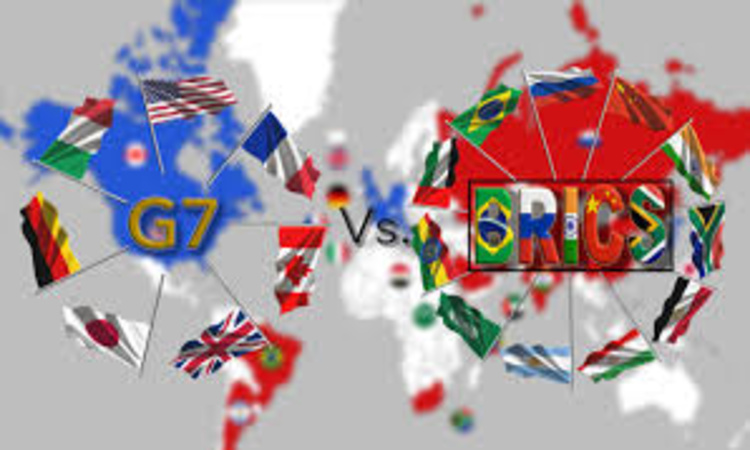
Comparing GDP Growth of BRICS and G7 in 2026
The eleven member countries of BRICS are projected to record an average
economic growth of 3.8% in 2025 and 3.7% in 2026. In contrast, the G7
economies are expected to grow by only 1% in 2025, with a modest increase
to 1.1% in 2026. This limited growth is largely attributed to economic
stagnation across Europe.
BRICS countries now account for nearly half of the world’s population and
are increasingly recognized as a powerful economic bloc with rising global
influence. Unlike many Western economies, BRICS members continue to
experience relatively rapid growth driven by large-scale investments,
expanding trade networks, and favorable demographic trends.
In an increasingly multipolar global order, the expansion of BRICS has
further strengthened its economic and geopolitical position.
Key Growth Projections
- India: 6.6% growth in 2025 and 6.2% in 2026, the fastest among BRICS members.
- China: 4.8% growth in 2025, with a moderate slowdown expected in 2026.
- G7 countries: Average growth of 1% in 2025 amid demographic and trade challenges.
- Germany: 0.2% growth in 2025, improving to 0.9% in 2026.
These trends reflect a widening economic growth gap between BRICS and the
G7, highlighting the shifting center of global economic momentum.